Nov 2025 – Mar 2026
2D-Axisymmetric CFD of an Actively Cooled EV Charging Cable
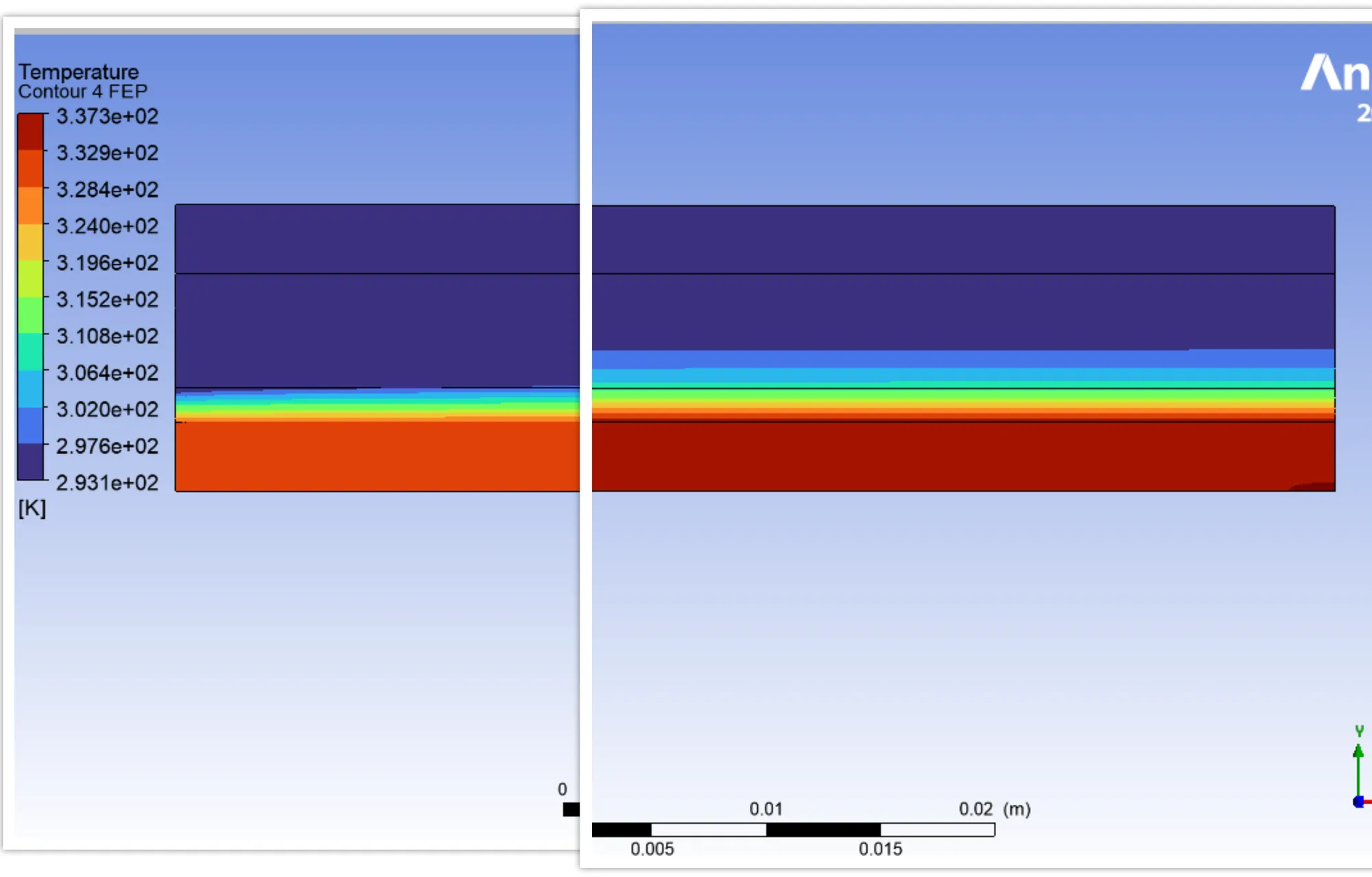
500 ADC load, 74.25 W of Joule heating
+3.38 °Ccoolant temperature rise (target > 3 °C)
≈ 64 °Cpeak copper temperature, XLPE limit 90 °C
Nu ≈ 5.8α_w = 346.7 W/(m²·K) at the channel exit
q‴ = I² ρe / Ac²αw = q″ / (Twall − Tbulk)
Problem
Fast chargers push currents of 500 A and more through the cable. The copper heats up by Joule effect, and the XLPE insulation around it degrades if it runs hot for long, which can end in dielectric breakdown. Natural convection to the air cannot remove this heat, so the cable is cooled by water flowing in an annular jacket. The question is whether that jacket keeps the insulation within its limit, with laminar flow and a coolant temperature rise above 3 °C.
Approach
- Model: a 0.5 m cable segment reduced to a 2D-axisymmetric domain with four layers: copper conductor (Ø 6 mm), XLPE insulation (1.5 mm), water jacket (5 mm gap) and FEP outer sheath (3 mm).
- Physics: steady, incompressible, laminar flow with conjugate heat transfer between all solid and fluid zones. The 500 A load enters as a volumetric heat source of 5.25 × 10⁶ W/m³ in the copper; the outer sheath loses heat to 25 °C air.
- Velocity choice: an operating window was derived between the boiling limit (0.001 m/s), the laminar limit (0.231 m/s at Re = 2300) and the limit for a ≥ 3 °C temperature rise (0.027 m/s). The inlet runs at 0.027 m/s and 20 °C.
- Numerics: structured mesh refined towards the jacket walls, pressure-based solver with SIMPLE coupling and second-order upwind schemes, residuals below 10⁻¹⁰.
- Verification: a second mesh with about twice the elements (43,450 → 98,010). Mass and energy balances close for both, and key temperatures change by less than 0.003 %.
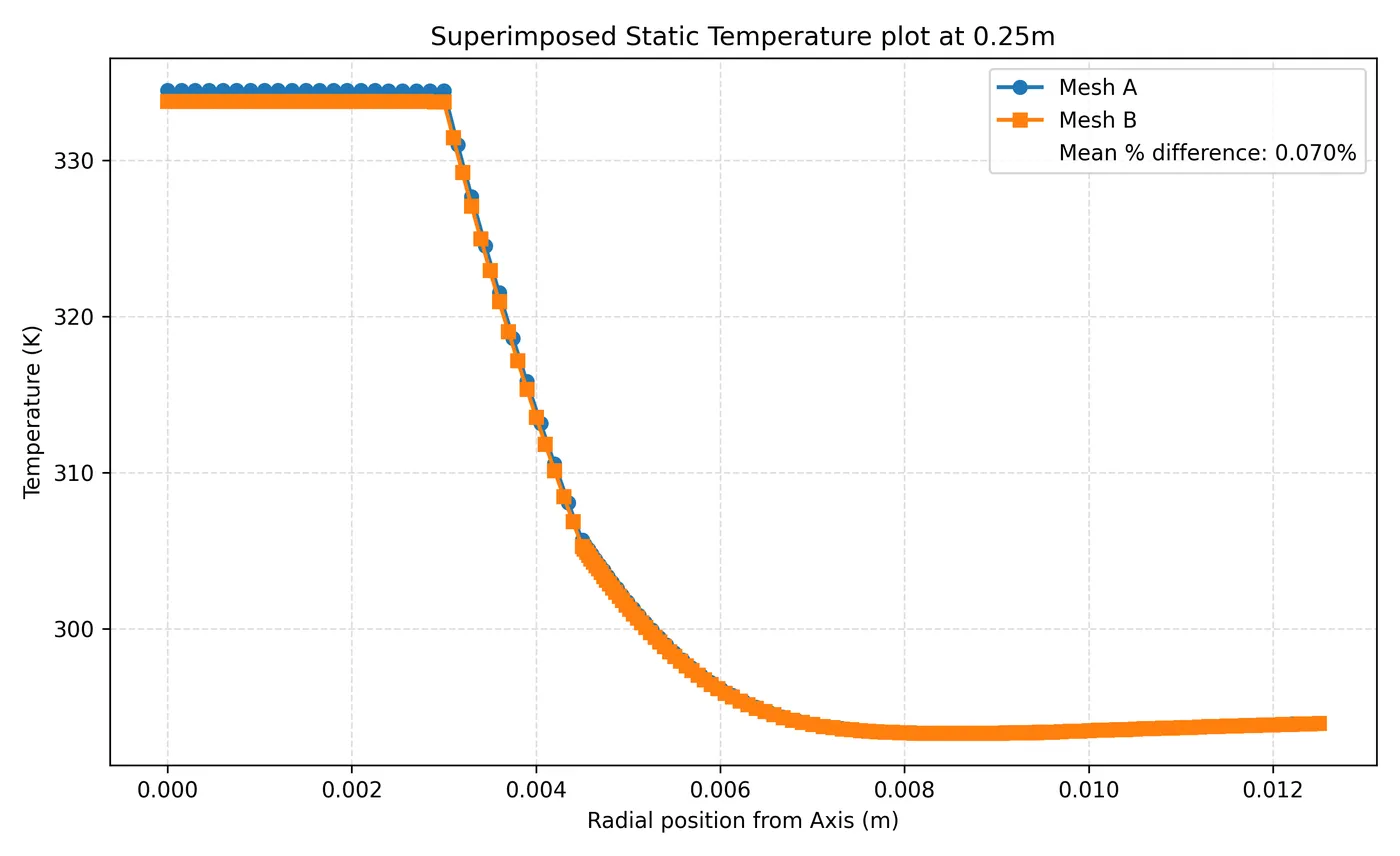 Grid independence: radial temperature at x = 0.25 m for both meshes; the profiles overlap.
Results
- Flow: the uniform inlet profile develops into a fully developed parabolic laminar profile, zero at both walls and peaking near the middle of the gap.
- Temperature: the copper is almost isothermal; the XLPE carries the steepest drop and is the main thermal resistance; a thermal boundary layer forms in the water; the FEP sheath stays only slightly above ambient. The hottest copper stays around 64 °C, well below the 90 °C XLPE limit.
- Coolant: the mass-weighted outlet temperature is 23.38 °C, a 3.38 °C rise that meets the design requirement.
- Heat transfer coefficient: on a 5 mm segment of the XLPE–water wall at the exit, αw = 4599.7 / (309.80 − 296.53) ≈ 346.7 W/(m²·K), giving Nu ≈ 5.8, in line with the analytical value for fully developed laminar flow in an annulus (5.4–5.8).
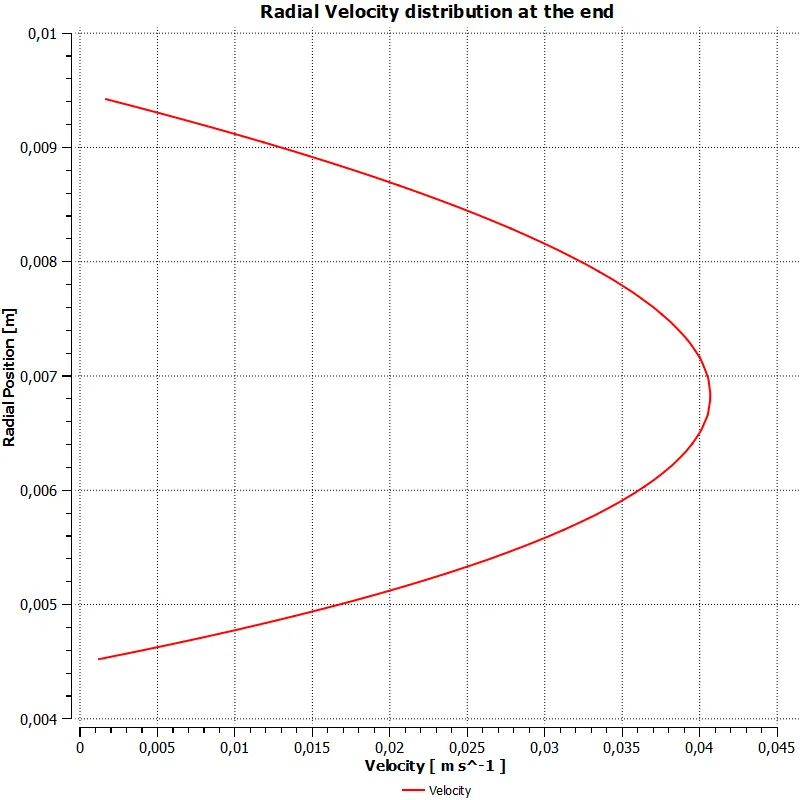 Velocity near the exit: a parabolic laminar profile across the water jacket.
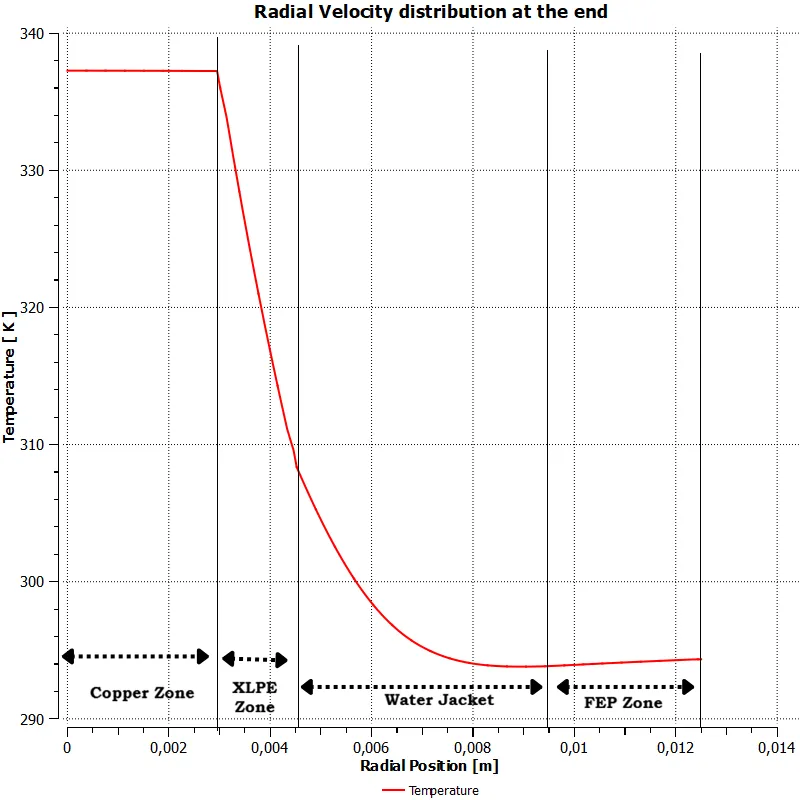 Temperature near the exit across copper, XLPE, water jacket and FEP sheath.