Aug 2023 – Aug 2024
Vision-Guided Autonomous Navigation of a Mobile Robot
8 / 8missions completed (1.5 m stand-off)
18 / 18search-and-centre trials, error 3.8 ± 0.6°
17 → 41 fpslive vision pipeline after buffer rework
252automated tests, no simulator needed
f(n) = g(n) + h(n)κ = 2y / Ld²
Problem
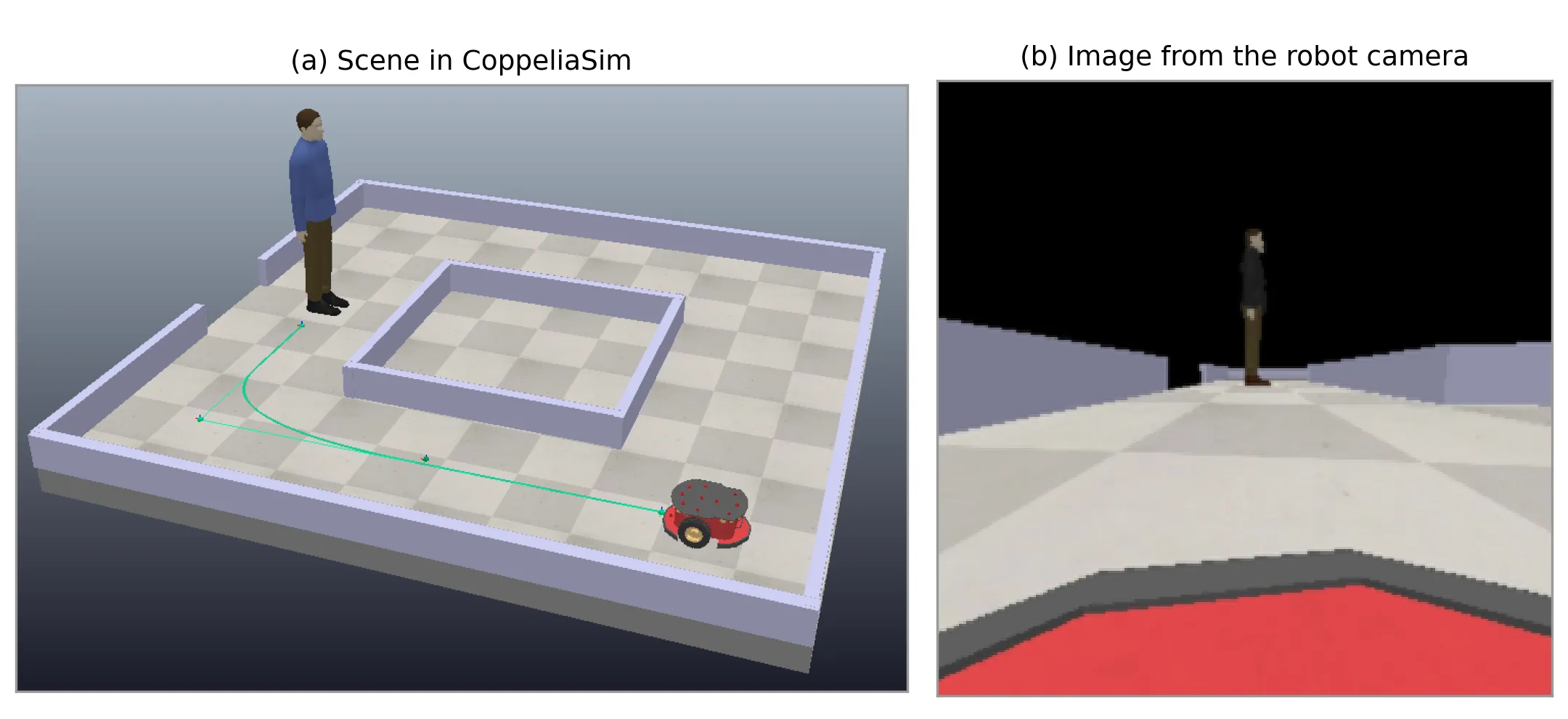
Make a simulated differential-drive robot find a person using only its camera, then plan and drive a safe path to stop in front of them. Each piece (control, detection, perception loop, planning) has to work on its own and be measured, not just demonstrated.
Approach
The work is split into four projects that build on each other:
- Robot control: Python connection to CoppeliaSim, differential-drive kinematics, pose, ultrasonic sensors, camera frames, teleoperation and trajectory logging.
- Object detection: YOLOv5 detector and a steering CNN, with evaluation tooling and blocked cross-validation.
- Vision pipeline: live camera → detector → display loop with per-stage timing, offline benchmarks and session recording.
- Autonomous robot: scene occupancy map, A* path planner, pure-pursuit path following, a staged approach and a final visual check.
Results
- Kinematic model validated: cruising speed 0.1944 ± 0.0025 m/s measured vs 0.1950 m/s predicted (−0.33 %).
- Vision-only search and centring: 18 of 18 trials centred on the person (final error 3.8 ± 0.6°); the first naive version managed 5 of 18.
- Speed: a direct-buffer camera path made frame fetch and conversion 50× cheaper (22.6 → 0.45 ms), raising the live pipeline from 17 to 41 frames/s.
- Full mission (find by vision, plan, drive, verify): 6 of 8 trials at 1.2 m stand-off, 8 of 8 at 1.5 m. A CNN-steered baseline on the same protocol completed 3 of 8.
- Camera calibration as a by-product: yaw offset of about 5.6° and an angular scale 7.7 % off the nominal 120° field of view.
What did not work
Reported as honestly as the successes:
- A custom-trained detector failed on simulator frames (highest confidence 0.002), so the stock YOLOv5s model was used instead.
- The steering CNN reached a balanced accuracy of 0.55 ± 0.06 on unseen driving (chance 0.33). An earlier 0.70 came from data leakage between random folds and was discarded.